
|
|
|
   |
Frank Meadow Sutcliffe Hon FRPS : 1853-1941
|
 |
|
Information from The Sutcliffe Gallery webpage
Frank Meadow Sutcliffe was born in Leeds in 1853 – just 14 years after the birth of photography. He was the son of Thomas Sutcliffe, an artist, lecturer and art critic.
In 1870 the family moved to Whitby, where they had often spent their summer holidays. His father died the following year and Frank, now the head of the family at eighteen, decided to make his living with a camera.
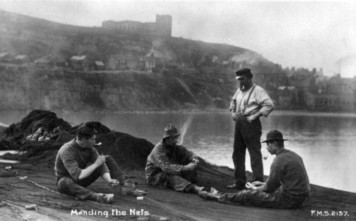
Whitby in Victorian times was a thriving tourist resort and Frank Sutcliffe became very successful taking studio portraits of the wealthy holiday makers and while this studio work paid the bills, Sutcliffe really wanted to photograph the everyday working people in Whitby and the beautiful surrounding countryside.
He developed an affection and respect for the town and its people which shines through his work, producing photographs which were not only of the highest technical merit, but also displayed great artistry.
Between 1880 and 1894, Sutcliffe was awarded around sixty gold, silver and bronze medals at exhibitions as far a field as New York, Tokyo, Berlin, Paris, Chicago and Vienna, as well as at major exhibitions in the UK.
The beautiful photographs taken by Frank Meadow Sutcliffe lived on at The Sutcliffe Gallery in Whitby from 1959 until 2019 where, for the previous 60 years, the Shaw family were custodians of the collection, always conscious of being responsible for a great National archive. Visitors from all over the world made a pilgrimage to the gallery and were fascinated to see how working people lived in Victorian England. The Sutcliffe photographs portray an immediacy and realism of everyday life that paintings of the period sometimes struggle to emulate. The gallery closed but sales of Frank Meadow Sutcliffe's amazing portrayal of Victorian Yorkshire are flourishing on-line (www.sutcliffe-gallery.co.uk). All the sepia photographs you see on their website were taken in and around Whitby by Frank Meadow Sutcliffe (Hon. F.R.P.S.) between 1875 and 1910.
Sutcliffe's large camera was made of mahogany with brass fittings and took 'whole plate' glass negatives (6.5"x8.5"). Photography in Victorian times was not an easy craft to master and people were often content to produce an acceptable image which was sharp and well exposed - but there were a handful of photographers who wanted to lift their pictures into the heady realms of 'Art'. Frank Meadow Sutcliffe was one of these artists and he became world famous as one of the greatest exponents of pictorial photography and was made an Honorary Fellow of The Royal Photographic Society in 1935, the highest award attainable.
The Sutcliffe Gallery was established in 1959 when we purchased the collection of 1500 original glass plate negatives taken by award winning Victorian photographer, Frank Meadow Sutcliffe. They have been the sole publisher of this unique collection ever since and after 60 years experience, the quality they are now able to achieve is stunning!
|
 |
LECTURE ON "BEAUTY" BY MR. F. M. SUTCLIFFE
Whitby Gazette - Friday 23 March 1900
|
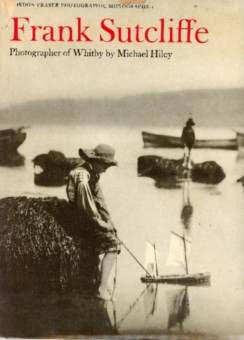 |
Book of Gordon Fraser Photographic Monographs
Inside front cover sleeve :
As one of the first men to devote his life and creative energy to photography, Sutcliffe moved away from the confines of Victorian photographic conventions which were based on artifice, and set himself the task of photographing the people and the countryside which he saw around him in as truthful and straightforward a manner as his equipment would allow. Although it was not in his character to publicise his own success, he was hailed by his contemporaries as one of the most original and outstanding photographers of his day. Although he rarely left Whitby, his work was known, exhibited and copied all over the world.
Michael Hiley has traced Sutcliffe's writings on photography, many of which are to be found only in newspaper archives, and specialist photographic libraries. Details which they reveal of how Sutfliffe went about his work as a photographer, his opinions on every subject from the artistic potential of photography to the art of handling recalcitrant babies in the studio, provide a unique insight into the attitudes and preoccupations of a photographer in the late Victorian period.
As the son of a painter, Sutcliffe was aware both of the unique qualities of photography and of the debt it owed to painting. The years of his greatest success were years of unprecedented upheaval in both painting and photography and this book sets out to establish the relationship between Sutcliffe's work and that of the leading photographers and painters of his time.
This book brings together for the first time the best of Sutcliffe's work - pictures taken for his own pleasure from family albums, exhibition photographs which won prizes all over the world, examples of his work as a professional portrait photographer, and snapshots from the Kodak collection, which reveal a second burst of creative activity late in his career.
64 duotone plates and over 80 illustrations in the text.
|