  
|
|
|
   |
Whitby Walk
Point 5 - Fish Quay
|
|
|
The sounds of gulls and the unmistakable nostril teasing smells of fish and brine will always take you to the edge of the town's quayside.
|
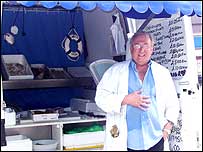
Brian and his van
|
The fish quay was a place where boys with their hand-lines have grown up to be men on trawlers, and girls have followed their mothers preparing bait or repairing nets. And fishing has been in their blood of generations.
As far back as 1536, the revered Augustinian Canon, Leland, noted Whitby as "A great fischar toune", and as such, the town continued to build on its sea harvesting skills.
And it's herring or "the silver darlings" that the town is most regaled for.
In line with the traditional agricultural harvest, August and September saw the herring fleets gather in the harbour at Whitby in such great numbers that, at times, you could walk from one side of the harbour to the other across their decks.
|
 |
Scottish invasion
But by the 1870s, herring fleets were not just Whitby's Yawls, Mules and Cobles.
With the word going out, that huge shoals of herring were there for the fishing, the destinctive Scottish lugger fleets with their Fifies and Zulus joined the throng.
Even fishermen from East Anglia and Cornwall took to these waters too.
Traditionally, most fish had been caught using either lines or drift nets. Fish that lay at the bottom of the sea bed would have been caught by hand line or long line strung out along the sea bottom.
And the women-folk played their part in the fishing fleet's success too.
Fish-wives, as they were affectionately called, were paid 1s 6d (7.5p) a day for their onerous and odorous work, counting the fish on board the boats.
But the buyer came off best.
Herring were sold by the "last", nominally, 10,000 fish. But, with four herring making a "warp", and 33 warps making a "hundred", and 100 hundreds making a last, it meant that the fisherman was paid for 10,000 herring while the buyer received 13,200 fish.
|
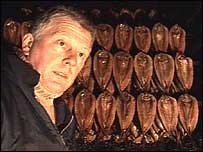
Barry is a fifth generation Fortune's smoker
|
Up in smoke
Significant growth for the fishing industry came in the middle of the 19th Century when the newly developed railways opened arterial routes out of Whitby, giving a life-line both in and out of the precariously located town.
Of course the perishable nature of the product meant that the railways were an ideal way of transporting the fresh fish, from the quayside market, inland.
The Fortune family business was run from Haglathe House until 1992, when we bought it from the Fortune family. It is perched at the foot of the cliffs beneath St Mary's Church. The smoke-house has been smoking Fortune Kippers for over 120 years.
While you are staying at Haglathe, it is worth seeing how the embers of the dying art of smoking fish are being kept aglow while the two Brown brothers, Barry and Derek, smoke the golden fish in the same way as their forebears have always done.
The tar from the oak and beech wood shavings that exudes from every inch of timber inside, has never been shaved off - the aroma is one that will linger with you for the rest of your life, once drawn in.
From Fish Quay, head past the Victorian bandstand and onto West Pier. Stop halfway down the pier.
|
|
|
|
|
|
|
|
|
|
|
|
|
|
|
|