  
|
|
|
   |
Whitby Walk
Point 6 - Bram Stoker
|
|
|
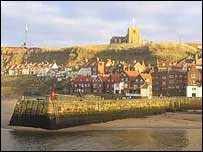
Look up at the ruined abbey on the cliffs above the town. It was high up on these cliffs that Bram Stoker, the Irish author, penned much of his novel Dracula.
|
 |
The dramatic happenings of one stormy night, brought Dracula to these shores and they continue to be a source of inspiration for countless thousands of Dracula aficionados today.
Whilst Dracula is a work of fiction, Stoker brought it close to reality by adopting the use of chronicled diaries and observations from key characters, such as Jonathan Harker, his girlfriend, Mina Murray and her close friend, Lucy Westenra.
|
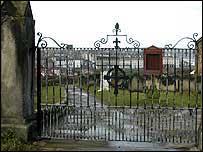
The gates of St Mary's
|
The devil amongst us
Stoker was meticulous with facts. The place names in the Transylvanian mountains were accurate - they do exist, as was even the timetable of the train that took Jonathan Harker, a London solicitor, to Castle Dracula.
His attention to detail can almost be felt in his writing about Whitby too. All adding to the plausibility of the novel. All adding to the plausibility of the novel.
His writing started in 1895 when Stoker stayed in Cruden Bay, some 20 miles north of Aberdeen, Scotland.
But it was while staying in Royal Crescent, Whitby, he witnessed a shipwreck that became a key feature within his novel.
During one of the storms that often ravaged the North East coast, the schooner, The Dimitre, ran aground on Tate Hill Sands.
Stoker's fertile imagination sprang into life with the shipwreck becoming Count Dracula's dramatic entrance to England - but in an all together strange way.
Stoker wrote: "But the strangest of all, the very instant the shore was touched, an immense dog sprang up on the deck from below, as if shot up by the concussion, and running forward, jumped from the bow to the sand".
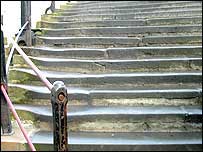
So it was that, in his guise as this dog, the Count leapt from the boat and ran from the beach and bounded up the 199 church stairs leading to St Mary's Church, perched high on the cliff top, close to Whitby Abbey.
It was Whitby's Abbey that was to suffer a more devastating visitation , when in the 1500s Henry VIII's "dissolution of the monasteries", it was summarily closed.
In the 1500s, the "dissolution of the monasteries", which Henry VIII will forever be labelled with, was in full flow. Not even Whitby's abbey was untouched.
But the Cholmley family bought the manorial rights of the Abbey in 1539 but its eventual demise was inevitable. The nave collapsed in 1762 as did the central tower and west front later in the 18th Century.
Today the haunting ruins of the abbey, founded in the 7th Century by the Anglo-Saxon Abbess, Hild or Hilda, still dominate the landscape for many miles - from seaward sight too.
With a little imagination, a lingering mist and maybe a haunting moon - it's easy to see why.
|
 |
Long live Dracula
And there are those, even today, that relive the Gothic life to the full - the Goths. Twice a year, in April and of course at Halloween, Whitby becomes "Goth City", with music, performances and celebrations of gothic life and times.
The popularity of the Goth subculture really took hold in the 1980s with bands such as The Sisters of Mercy, The Cure, and Siouxsie and the Banshees.
The era of Punk and the New Romantic was here to stay, at Whitby - where Dracula first set foot on English soil.
Now head further along the pier, stopping when you reach the lighthouse.
|
|
|
|
|
|
|
|
|
|
|
|
|
|
|
|