  
|
|
|
   |
Whitby Walk
Point 10 - A Holy Town
|
|
|
George Young - as an accomplished geologist, a talented theologian and a much loved pastor - was a guiding light of Whitby
|
 |
Born in 1777 in Scotland on his parents’ small farm near Edinburgh, he might have been expected to follow them into farming had he not been born with only one hand.
George Young's disability diverted him into a world of academia and a lifetime of research into the relationship between faith and science.
He grew up in a Christian family who encouraged him to seek ordination in the Scottish Presbyterian church.
At Edinburgh University, he excelled in maths and natural sciences but his high honours result was to be followed by a further five years of theological study to prepare him for his life’s work.
|
Young brought more than religion
|
Whitby bound
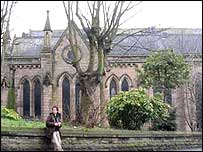
Five years after ordination into the Scottish presbytery in 1801, he found himself in Whitby as pastor to the United Associate (or new Presbyterian) Congregation chapel here in Cliff Street.
The job was perfect. He practised his ministry while pursuing his great passion for geology and palaeontology in Whitby’s remarkable landscape.
Young was competent in a number of classical and modern languages but his agility of mind was matched by his philanthropic nature.
He developed his own short-hand which he used for writing sermons and he was, by all accounts, a good preacher. After his death his congregation fixed a monument over the pulpit of the church for having "preached the Word of God within these walls with unabated zeal for 42 years."
After marrying Margaret Hunter, who was Whitby born and bred, he achieved considerable notoriety following the publication of his “History of Whitby and Streonsalh Abbey in 1817”.
This was followed by “A Geological Survey of the Yorkshire Coast, describing the strata and fossils between the Humber and the Tees from the German Ocean to the Plain of York”.
George Young published over 20 books ranging from the evangelical to the biographical - including that of Captain James T Cook.
|
 |
The Lit & Phil
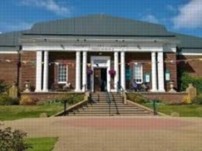
Perhaps his most enduring legacy to the town was The Whitby Literary and Philosophical Society founded in 1823 by a group of Whitby’s citizens under his leadership. As the umbrella organisation for the Whitby Museum, it remains an active part of the historic life of the town.
The Society aimed to set up a museum specialising in fossils since “Whitby is…abounding with petrifactions and containing not a few antiquities”.
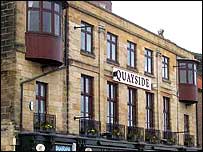
The Museum opened in rooms over a shop in Baxtergate but soon moved to a building on the Quayside where it continued to grow.
He concluded, from his geological and theological studies, that there was good evidence for Noah’s flood and further came to the opinion that God had created the world in six literal days about 6000 years ago.
“It gives us no small pleasure to observe that the geological facts which have come under our review do not contradict but confirm the sacred Scriptures.”
He was an admired scholar in both of his chosen disciplines but many of his contemporaries, both scientists and clergy, disagreed with his findings.
The debate continues today although the greatest weight of opinion no longer lies with the thoughtful Presbyterian.
In 1848, he died at the age of 71 and appears to have been greatly mourned by local people who valued the simplicity of his faith and the humility of their clever and gracious minister.
|
|
|
|
|
|
|
|
|
|
|
|
|
|
|
|