  
|
|
|
   |
Whitby Walk
Point 8 - Smuggling and Whaling
|
|
|
The 'free trade' of smuggling was rife in the 18th Century. And smugglers on the south coast of England were perhaps the leading exponents of that devious art
|
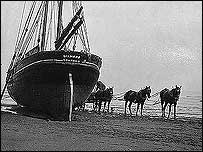 |
But the North East fared well, and the port of Whitby, with its growing maritime traffic was ideal as a receptacle for all manner of contraband.
There were some extraordinary quantities of "imported" goods brought ashore from sailing craft of every sort. From coastal luggers to inshore "cobles", sailing craft had the quiet of the wind to drift into port under cover of darkness.
Skinner Street was, as one colourful story goes, the hub of a clandestine trade that touched even those in authority.
|
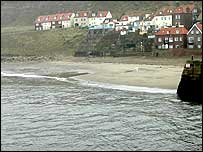
Many a beach became a smugglers' paradise
|
Dirty dealings
Captain Harold Hutchinson of the Dragoon Guards based in Guisborough was called out to attend what turned out to be a riot of a battle on Whitby's quayside in the late 1700s.
The Dragoons after quelling the disturbance ended up being ordered to stay in Whitby for three years, enforcing the law as much as they could.
Captain Hutchinson was quickly made Customs Officer, and, as the story goes, managed to avail himself of certain items of contraband before they were spirited away for "trade".
Such was the extent of his dealings; he amassed not inconsiderable wealth and was able to afford to build a fine dwelling in Skinner Street which became known as "Harold's Mansion".
It is said that success breeds success. Captain Hutchinson knew how to manipulate such a virtue.
As time went on, he turned his mansion into a bordello that was frequently patronised by visiting seamen, servicing a trade that built wealth on wealth for the Captain.
|
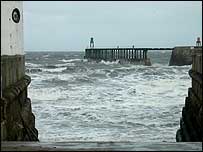
The sea greatly affected smuggling
|
A blossoming business
It was reckoned that around these hazy days of smuggling that 80% of all tea consumed in England was "duty free" and on a single smuggling trip 3,000 gallons of spirits could be imported. Gin, in fact, was so cheap that it was used for cleaning windows.
Church Street on the other side of the River Esk was also central to Whitby's smuggling fraternity.
Housewives of the town would be seen going to market wearing loose-fitting garments, only to return with buttons bursting, having stuffed their clothes with contraband goods.
An entry in The Times newspaper chronicaled the dealings of the day, "Yesterday se'nnight the Fawn, smuggling lugger, with a thousand ankers and half ankers of rum, brandy, and geneva, to the amount of 6000 gallons, was taken and sent into Whitby, by the Eagle cutter.
Capt. George Whitehead, in the service of the revenue at that port with the assistance of the Mermaid and Capt Carr. The Fawn is a fine clinch built vessel of 90 tons built at Flushing four months since, mounting six four pounders and six swivels. Her crew consisted of twenty-two men", 31 August 1790
Captain Hutchinson and his compatriots were always living on the wrong side of the law - nothing much else is recalled of the cunning captain, but the "free trade" went on.
A costly trade
Next to you at this point is Whitby's whalebone arch - a reminder of the men who once hunted the whale, and the rich life of oceans.
200 years ago the women of Whitby would climb up and stand on this bleak headland to watch their husbands and sons leave for the icy North on whaling expeditions.
At the whaling industry's peak, over 20 ships sailed from Whitby. But a catastrophic shipwreck 30 miles outside the town in 1826 was just one demonstration of the terrible price sometimes attached to this successful trade. 200 men were lost - and just 3 saved - when the Esk went down in a violent easterly storm.
From the Whalebone Arch, look across to the Abbey, then turn round and walk in the opposite direction, until you reach Royal Crescent.
|
|
|
|
|
|
|
|
|
|
|
|
|
|
|
|