  
|
|
|
   |
Whitby Walk
Point 1 - Shipbuilding
|
|
|
Standing outside Whitby's tourist information centre, looking towards the River Esk as it joins the North Sea, don't be fooled by the peaceful setting and quaint skyline.
|
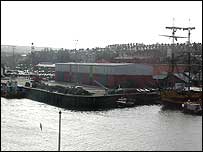 |
Whitby’s tranquil façade belies the town’s prosperous history as the country’s most productive centre of shipbuilding.
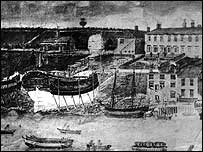
From the mid-18th to the mid-19th Century, the area from the bridge to what is now the Marina car park, was a bustling cluster of shipyards, roperies and sail yards. If you look across the river, however, you'll be able to see Parkol Marine still building ships.
Only the seagulls remain now, whose squawks would have been drowned out by the sound of the caulkers’ hammers, working to ensure that Whitby’s ships remained watertight.
At the industry’s peak, Whitby was the third largest centre of shipbuilding, after London and Newcastle.
The geography of the town and port is responsible for the town’s strong maritime associations. Long before its shipbuilding industry had taken root, Whitby was a safe haven for passing ships, in an otherwise inhospitable coast.
The combination of numerous passing ships and the isolation caused by the North York Moors meant the sea soon became Whitby’s principle mode of transport.
|
 |
Shipbuilding in the blood
Those employed in building Whitby’s ships, and their employers, lived close to the yards in dwellings which have since disappeared. The shipbuilding Barry family lived in a house which was destroyed to make way for the bus station, whilst the Fishburns lived at Esk House, which was destroyed during World War Two.
The skilled craftsmen responsible for designing Whitby’s ships left their imprint on the Old Town - the maze of steps, yards and houses has a distinctively nautical feel.
The industry pervaded all walks of Whitby life. Many local people invested money in the town’s shipyards as a safe investment. Various wills show people who had no connection to the yards owning shares in shipbuilding companies.
The town’s great success as a centre for shipbuilding was helped by the port's reputation for building ships that were both durable and strong.
|
 |
World-wide fame
In the 19th Century, William Scoresby and his son, William Junior, undertook their first Arctic adventure in a Whitby built vessel.
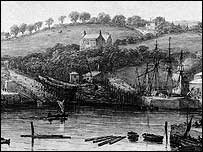
They succeeded in penetrating the Arctic ice further than anyone else. Cook’s three famous ships, the Endeavour (1764), Resolution (1769) and Adventure (1770) all began life in Thomas Fishburn’s shipyard.
The distinctive design of Whitby’s "cats" was perfectly suited for Cook’s famous exploration of the South Seas.
The flat-bottomed design was developed to serve the alum trade, for which ships needed to "take the ground" safely. This feature made them ideal for Cook’s adventures too, when he landed in unknown waters, without harbours.
Whitby’s shipbuilding industry was also responsible for important, far-reaching technological advances.
William Scoresby (Senior) designed the crow’s nest, a design feature subsequently adopted across the world. Although evidence of Whitby’s shipyards is now hidden beneath car parks, bus and railway stations, at least one by-product, the crow’s nest, stands high on ships across the world.
So let's start the walk, and move on to the bridge heading towards the museum of Whitby's famous mariner - Captain Cook.
|
|
|
|
|
|
|
|
|
|
|
|
|
|
|
|